![[object Object]](https://i0.wp.com/new.divinemercy.sg/wp-content/uploads/2019/12/adoration.jpg?resize=1080%2C984&ssl=1)
Faith Doesn't Ask Anything in Return, Does It?
Specifically, you can ask, hope, or pray for something, but faith is not a transaction. It is more about the posture of faith itself
#catholic
#religion
#faith
EN
• 9 min read
People often welcome the truth when it supports their beliefs and egos. But some people may resist, deny, or become hostile toward the truth when it exposes their mistakes, challenges their worldview, or requires them to change.
People love the truth when it washes them, but hate the truth when it proves them wrong.
Truth is easy to defend when it is on our side.
The real test is when the same truth shows that we are the one who is wrong.
On July 1, 2026, the Society of Saint Pius X (SSPX) consecrated four bishops without permission from Rome. Like always, social media exploded. People started accusing, condemning, and arguing about Church authority, obedience, and canon law.
But behind this canonical debate, there is a bigger problem. And actually, it is closer to us here in Indonesia than we think.
It is also worth mentioning that this is not simply a case of the whole Church against one rebel group. Bishop Joseph Strickland, Bishop Emeritus of Tyler, Texas, is a bishop still in full communion with Rome, yet he came out in support of the SSPX’s decision.1 He argued that the SSPX’s move should not be read as rebellion, but as a response to what he sees as a spiritual “state of necessity,” because he believes the current hierarchy’s doctrinal ambiguity is causing a real rupture in the Church. For him, the deeper question is not really about who follows the correct paperwork, but about who is actually protecting Catholic truth.
People also often forget that the SSPX did not just skip straight to consecrating bishops without trying to talk to Rome first. SSPX Superior General Fr. Davide Pagliarani had defended the consecrations by citing a state of necessity, arguing that the society only had two aging bishops left to ordain new priests.2 Earlier, on February 18, the SSPX actually rejected a Vatican request to postpone the ordinations and enter a structured theological dialogue about Vatican II.3 Talks did happen through Cardinal Fernández at the Dicastery for the Doctrine of the Faith in February, and Rome hoped this dialogue could convince the SSPX to pause its plan, but the society’s leadership eventually closed the door on further negotiation.4 So it’s not that there was zero communication. There was communication, it just dragged on for months without any real solution, until the SSPX leadership felt like waiting any longer was no longer an option for them.
Note: the liturgical norms cited below govern the Roman/Latin Rite, which is also the rite of SSPX and of the Catholic Church in Indonesia. The Eastern Catholic Churches follow their own liturgical law (the Code of Canons of the Eastern Churches) and are not in view here.
A lot of Catholics are very enthusiastic to defend Church authority when that authority is criticizing a group they already dislike, like SSPX. Suddenly they know canon law very well. Suddenly obedience to Rome matters a lot. Suddenly liturgical norms must be respected no matter what.
But is this kind of obedience real, or is it just convenient?
In Indonesia, there are actually quite a lot of practices that some people, especially those who care a lot about liturgical faithfulness, would call violations of the same norms. But these practices almost never get the same amount of attention as the SSPX case.
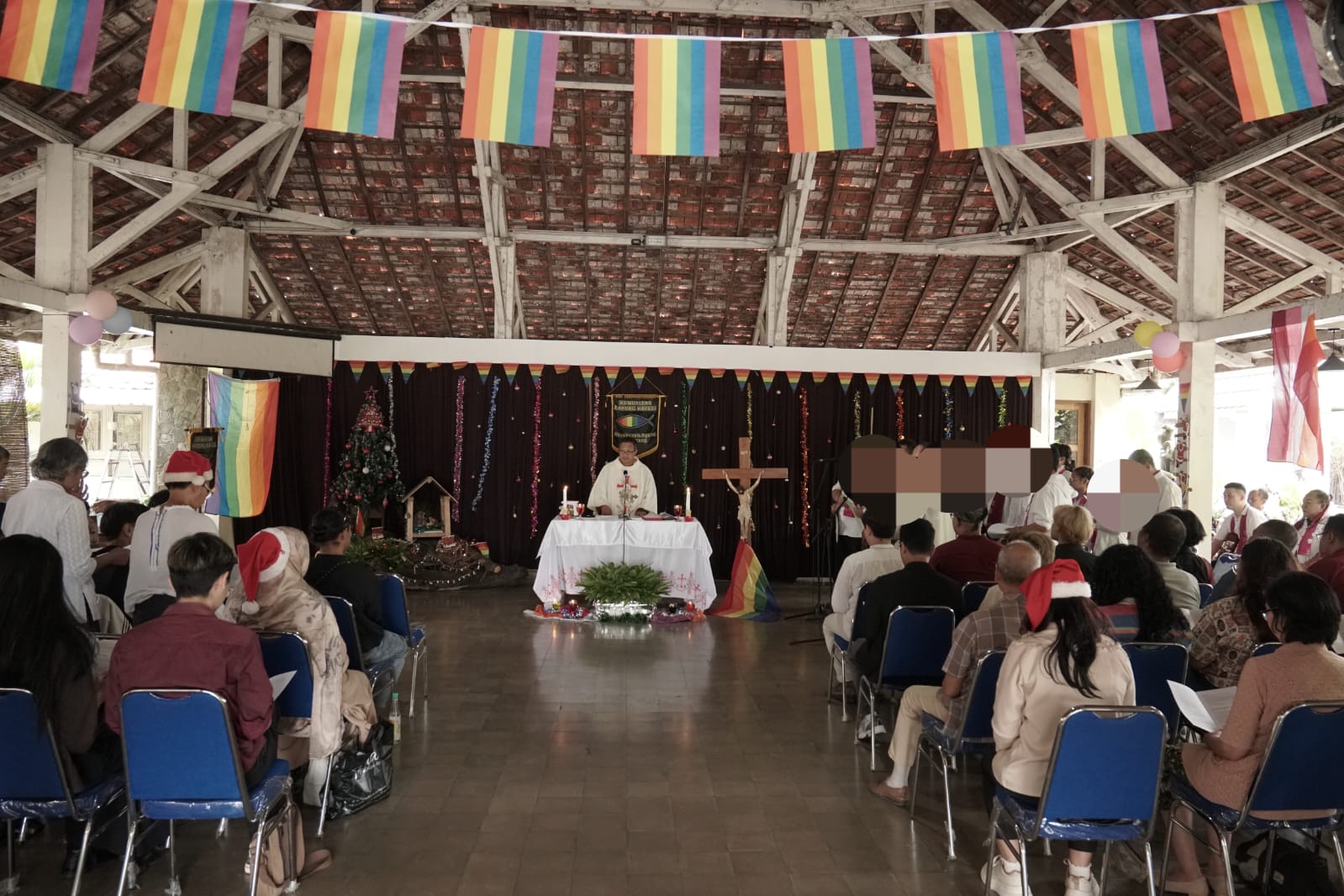
In the Archdiocese of Semarang (KAS), there is a community called Layung Kristi, which is for Catholics who identify as part of the queer/LGBTQ+ community. This community is officially under KAS’s Kevikepan Kategorial, which is the official structure that manages more than a hundred categorical communities in the diocese. Layung Kristi regularly holds retreats, recollections, and also Mass.
The diocese itself explains this ministry as a pastoral effort, a way to reach out to people who feel excluded so they still feel welcomed by the Church, without this meaning the Church agrees with actions that its teaching considers sinful. But some Catholics, including some priests, have openly questioned the use of LGBT symbols and attributes during Mass, because it can look like the celebration is honoring something the Church officially teaches as sin, not just showing pastoral care to the person. Even a KAS official once warned that categorical communities can “lose the root of the Catholic faith” if their focus shifts from Christ to their own group’s experience, a warning from inside the Church that almost nobody quotes as much as they quote condemnations of SSPX.
This is actually a good example to show how complicated this topic can be. There is a sincere pastoral intention on one side, and there is a real concern about liturgical and doctrinal faithfulness on the other side. But because it is complicated, people usually just pick a side, either defending it completely or attacking it completely, and rarely discuss it honestly.
Masses like Satu Suro Mass or Imlek (Chinese New Year) Mass often mix symbols, rituals, or elements from non-Catholic beliefs into the celebration of the Eucharist. Usually the goal is inculturation, meaning respecting local culture, and this is actually something the Church has encouraged since Vatican II.5 But when these elements are mixed without a clear theological study of what is purely cultural and what actually carries ritual meaning from another belief system, the line between valid inculturation and forbidden syncretism becomes blurry.
Receiving Communion without confession first, even when the person knows they are in a state of mortal sin, is one of the most common violations that nobody talks about, because it is a personal and invisible thing. Church teaching on this is actually clear and has not changed,6 but almost nobody has the courage to bring it up openly.
Putting a small performance or show by children into the homily part of Mass might look cute and can make the Church feel closer to young families. But this changes the homily from proclaiming the Word of God into some kind of entertainment segment, which is not something allowed by any liturgical rubric.7
Liturgical dance, if it really comes from an approved inculturation tradition, does have its place.8 But a lot of the dancing added into Mass looks more like a stage performance than a valid liturgical expression, and it is often done without approval from the local liturgical authority.
Clapping during homily, at the end of Mass, or after the mass because the choir pulled out an “impressive” performance. it might look small, but it changes the atmosphere of worship from something contemplative into something like a performance being judged by an audience, which liturgical guidelines have actually warned against for a long time.9
Historically and by norm, the organ is considered the most suitable instrument for the solemnity of the Eucharist.10 But in many parishes, instruments get changed based on personal taste, Piano, Violin, Electone with orchestra registration or an orchestra ITSELF, without really thinking about whether these instruments help or actually distract from the worship.
Some inculturated Masses are held with traditional dances, local languages, or local rituals added in, without going through the official approval process from the Bishops’ Conference like it is supposed to. The liturgical norms actually do allow inculturation, but through a regulated process, not by each parish improvising on its own.11
The list above is not meant to judge one specific group or to justify the criticism against SSPX. Actually, it’s the opposite. This list is meant to show that if we demand obedience to liturgical law and Church authority when we criticize SSPX, we owe the same standard to ourselves and to our own parish.
If liturgical norms matter, they should matter everywhere, not only when we use them to criticize traditionalist groups.
If pastoral love should be extended to groups we disagree with, that love should also be given consistently, not used selectively to excuse looseness on one side while demanding strictness on the other side.
Every Catholic should want to be faithful, faithful to doctrine, faithful to the sacred liturgy, faithful to charity, faithful to justice, and maybe most importantly, faithful to intellectual honesty.
If we condemn a violation in one place but defend the same kind of violation somewhere else just because it happens in our own circle, we are not really defending truth anymore.
We are defending ourselves.
Bishop Strickland and the Consecrations: A Plea for “Apostolic Continuity,” FSSPX News — https://fsspx.news/en/news/bishop-strickland-and-consecrations-plea-apostolic-continuity-57098 ↩
SSPX Consecrates Bishops in Defiance of Rome’s Schism Warning, National Catholic Register — https://www.ncregister.com/cna/sspx-consecrates-bishops-in-defiance-of-rome-s-schism-warning ↩
Cardinal calls for Vatican commission for SSPX defectors, The Pillar — https://www.pillarcatholic.com/p/cardinal-calls-for-vatican-commission ↩
‘Please turn back’: Pope Leo gives final warning to SSPX, The Pillar — https://www.pillarcatholic.com/p/please-turn-back-pope-leo-gives-final ↩
Second Vatican Council, Sacrosanctum Concilium (1963), arts. 37–40; Congregation for Divine Worship and the Discipline of the Sacraments, Varietates Legitimae: Instruction on Inculturation and the Roman Liturgy (1994) — https://www.vatican.va/roman_curia/congregations/ccdds/documents/rc_con_ccdds_doc_19940125_inculturation_en.html ↩
Code of Canon Law (1983), can. 916; Congregation for Divine Worship and the Discipline of the Sacraments, Redemptionis Sacramentum (2004), nos. 80–84 — https://www.vatican.va/roman_curia/congregations/ccdds/documents/rc_con_ccdds_doc_20040423_redemptionis-sacramentum_en.html ↩
Redemptionis Sacramentum (2004), nos. 64–66, 74 (laypersons may never give the homily; the homily must expound Church doctrine, not entertainment); Sacrosanctum Concilium, art. 52. ↩
Congregation for Divine Worship, “The Religious Dance, an Expression of Spiritual Joy,” Notitiae 11 (1975) 202–205, described by the Congregation as an authoritative reference on the matter; Congregation for Divine Worship, Responsum ad dubium (10 September 2012), confirming that dance is not foreseen in Roman Rite liturgical law unless approved by an Episcopal Conference and confirmed by the Holy See. ↩
Congregation for Divine Worship and the Discipline of the Sacraments, Directory on Popular Piety and the Liturgy (2001), no. 17 (rhythmic clapping among some peoples must remain an expression of communal prayer, not a spectacle); Varietates Legitimae, no. 42. ↩
Sacrosanctum Concilium, art. 120 (the pipe organ held in high esteem in the Latin Church; other instruments admitted only with the approval of the competent territorial authority and if suited to sacred use); Sacred Congregation of Rites, Musicam Sacram (1967). ↩
Sacrosanctum Concilium, art. 22 (regulation of the liturgy belongs solely to the Apostolic See and, within limits, to the bishop — no one else, not even a priest, may add, remove, or change anything on his own authority) and arts. 37–40; Varietates Legitimae. ↩
Specifically, you can ask, hope, or pray for something, but faith is not a transaction. It is more about the posture of faith itself
![[object Object]](https://upload.wikimedia.org/wikipedia/commons/thumb/3/31/Nicaea_icon.jpg/960px-Nicaea_icon.jpg)
Membedah syahadat Nikea Konstantinopel, salah satu syahadat yang paling penting dalam sejarah Kekristenan, dan bagaimana hal itu mempengaruhi iman saya sebagai seorang Katolik.
![[object Object]](https://cdn.britannica.com/20/172220-050-A75971D5/Cardinals-St-Peters-Basilica-mass-selection-pope-March-12-2013.jpg)
Refleksi perjalanan iman saya sebagai seorang Katolik, dari sekadar menjalani tradisi hingga menemukan makna liturgi, sakramen, dan panggilan pelayanan.